Mobile apps have been growing Ginormously since their inception. Every day we come across the news of some new app being launched in the market. Though this world of app development is very exciting, sometimes it’s confusing too especially when it puts a question before you while development- whether to go for a native app or hybrid app? Choosing from these two can be very challenging as both of these programming languages — Hybrid and Native, come with their pros and cons.
Understanding the differences between native, hybrid, and web apps is the first step in future-proofing your digital strategy. While native apps are built for a specific platform (iOS or Android), hybrid apps leverage a native ‘wrapper’ to house a web-based application. This architecture allows your app project to access device features like the camera or GPS without the massive overhead of separate codebases. By utilizing a single codebase with HTML5, CSS3, and JavaScript, businesses can achieve cross-platform compatibility that rivals traditional native builds, ensuring a seamless experience for your entire intended audience.
What are Hybrid Mobile Apps?
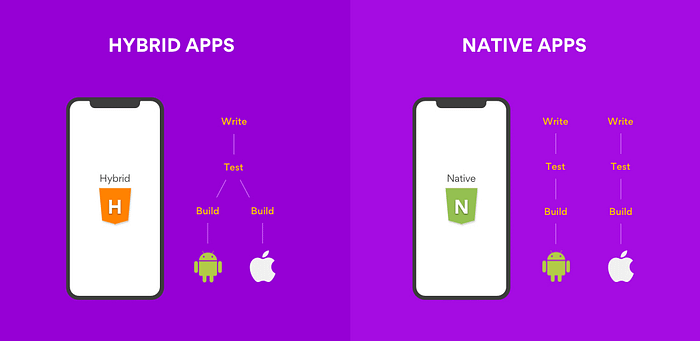
The combination of native as well as mobile apps is called the Hybrid apps. Just like native apps, they have to be first downloaded in an app store and then the app can utilize any of the features which a device has. As far as the web app part is considered, they rely on HTML being provided in a browser embedded within the app.
A hybrid app consists of an HTML5 web app within a native ‘wrapper.’ This is a mobile app written using HTML5, CSS3, and JavaScript, and then compiled into native iOS, Android, or other mobile platform using wrapper technologies.
Hybrid apps combine the benefits of the website and the app. Some programmers choose hybrid apps to conveniently incorporate device features such as push, camera, or GPS notifications. They have the extra benefit of obtaining Google’s and Apple’s platform’s customer base since apps are available through the App stores. Because they’re still basically web programs, they’re more economical to develop but might require experts that have more specialized knowledge of the different interfaces and features of their phone.
Why Hybrid Apps are set to Trump Native Apps in the Future?
:: App Store Limitation
Today, releasing a native mobile app involves packaging the code, submitting it to the app store, and waiting for it to be approved. The entire process can take anywhere from two to seven days. This is an eternity in the mobile world. Mobile app developers want to be able to update their mobile apps like their web apps, multiple times a day if necessary. This is not possible with the limitations of app stores, and hybrid apps are the way out.
:: Code Reuse
As most apps have an iOS and an Android version, they are developed using each platform’s preferred programming language — Objective-C or Swift for iOS, and Java for Android. Hybrid apps, on the other hand, let you build mobile apps with the same languages your developers are already familiar with — HTML, JavaScript, and CSS. You can write code once, and deploy it across all your mobile platforms. Mobile app testing equally benefits because you don’t need to write unique test scripts for each app type. Testing against a single codebase also reduces the testing infrastructure you need and simplifies the QA process. With the increasing fragmentation in device types and OS versions, this is becoming a necessity for mobile development.
:: DevOps for Mobile
Finally, hybrid apps let you extend DevOps to your mobile apps, too. They let you go from mammoth quarterly app updates to a bi-weekly cycle, and eventually let you update as frequently as your web app — which is close to impossible with native apps today. To update at this frequency, you’ll need to automate the two key parts of your continuous integration (CI) process — builds and tests. This is where tools like Git, Jenkins, and Appium have a key role to play. When well-integrated, they can let you focus exclusively on developing and testing your app, rather than worrying about mobile platforms’ norms. This gives you the confidence to release multiple times a day, and take ownership of your mobile development process.
Why Hybrid Apps are set to Trump Native Apps in the Future
One of the most significant benefits of hybrid app development is the substantial reduction in Total Cost of Ownership (TCO). Because developers write code once, businesses save on research, specialized APIs, and redundant library management. This efficiency directly leads to a faster Time to Market (TTM), allowing companies to reach a wider audience—capturing both the 73% Android and 26% iOS global market shares simultaneously. In a climate where hybrid apps demand is skyrocketing, this ability to scale rapidly across infrastructure systems ensures your business achieves its ‘go-live’ thresholds considerably faster than through manual native validation.
Flutter — The revolution in Hybrid Technology
This free and open-source platform allows the developers to build highly-interactive native interfaces on iOS and Android in record time. Its ability to speed up the entire app development process assists the developers in reaching a wider base of audience. let’s understand how this SDK, Software Development Kit, will prove to be beneficial for the app development industry as well:
:: Faster App Development Process
Flutter supports both IOS and Android, making it a feasible option for cross-platform app development. It allows the developers to modify widgets and build a highly engaging native interface. Also, the immensely productive rendering engine makes it a great choice for developing native platforms.
:: Striking User Interface
Having an eye-catching user interface is always a big plus for a mobile app. Flutter features Material Design and Cupertino for Android and iOS apps, respectively, that assist the app developers in building highly engaging apps. These are set of visual and motion-rich widgets that make the app look beautiful and interactive on both platforms. These apps are easy to navigate and extremely user-friendly.
:: Accessible Native Features and SDKs
Flutter further makes your app development journey delightful through native codes, third-party integrations, and platform APIs. You can easily access the native features and SDKs on both platforms and reuse the widely-used programming languages for IOS and Android such as Swift and Kotlin.
:: Highly Reactive Framework
With Google Flutter, you can easily modify the interface by changing the variable in the state. Consequently, all changes will reflect in the UI. Also, Flutter makes it easier and quicker to set up the application compared to React Native.
The shift toward this technology is already visible among global industry leaders. When looking at the top hybrid apps in the market today, giants like Amazon, Nike, and Walmart lead the charge. In fact, roughly 74% of the top retail applications are now built using hybrid app development methodology. These apps prove that with the right UI/UX design and optimization, a hybrid solution can deliver a highly-interactive interface and excellent performance even under high traffic conditions. Their success highlights how versatile frameworks like React Native and Flutter have matured to support enterprise-level demand.
So, Will Hybrid Apps Replace Native Apps?
We are at a stage of infancy when it comes to choosing between platforms (there are only four — Windows, HTML, iOs, and Android). To conclude, hybrid apps are a much cost-effective way for a company to port over their app. Their technical person does not need to learn a new language or even hire someone to do it.
But on the other side, the user experience in native apps is something that the company cannot ignore. For example, iOS users and developers know the apps inside out. Without customizing the UX for each platform, the apps won’t work the way they worked before, thus, the lack of functionality and eventually losing their app users.
If you are planning to have your own mobile application, website, custom web app designed by a professional design team, or Have any type of query or concern regarding its concept, technical know-how, the best way to get it done then don’t hesitate to reach out to us .